

Work‑Related Traumatic Brain Injury: Most Commonly Prescribed Medications in Early Recovery
When a worker sustains a traumatic brain injury (TBI) on the job, the medical decisions made in the first few weeks matter far more than most people realize. The medications prescribed during early recovery do more than manage pain or help someone sleep — they influence how the brain heals, how well the worker participates in therapy, and whether the claim moves toward closure or toward long‑term disability. Work‑related TBIs already carry a higher risk of prolonged disability and elevated claim costs compared to many other injury types [1]. Early pharmacologic decisions either improve those odds or quietly worsen them.
For PBMs, adjusters, and case managers, understanding which medications are commonly prescribed in early TBI recovery — and which ones introduce risk — is practical knowledge that directly affects claim management.
Why TBI Changes the Medication Calculus
Most work injuries follow a predictable treatment path: control pain, reduce inflammation, allow tissue to heal. TBI is different. The injured brain is unusually sensitive to medications that alter brain chemistry or suppress the central nervous system (CNS). This includes many drugs routinely used for TBI symptoms, such as sleep aids, anxiety medications, certain antidepressants, and opioids [2,3].
These medications may reduce a symptom on paper while simultaneously slowing neurological recovery, which can manifest as missed therapy appointments, delayed functional progress, and return‑to‑work timelines that continually extend.
The Main Medication Classes and What They Mean for the Claim
Pain Management:
Post‑traumatic headache affects up to 90% of TBI patients [4].
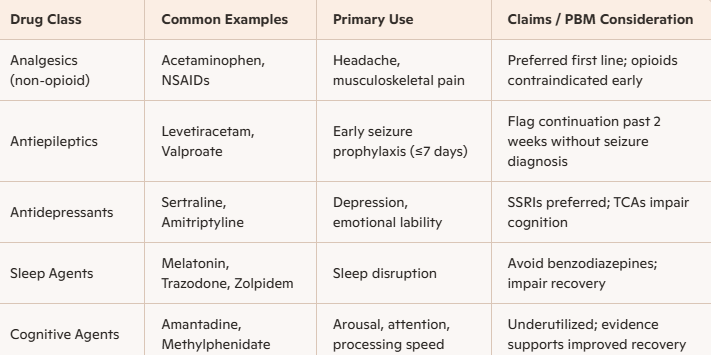
Acetaminophen and NSAIDs are appropriate first‑line options.
Opioids, however, add cognitive impairment to an already impaired brain and increase fall risk. They are associated with worse neurological outcomes in TBI [5]. Seeing an opioid early in a TBI claim is a clear warning sign.
Seizure Prevention:
Antiepileptic drugs (AEDs) such as levetiracetam are commonly used for the first seven days after moderate‑to‑severe TBI to reduce early seizure risk [6]. Evidence does not support continuing them beyond that window unless the patient has a documented seizure disorder. Prolonged use can cause sedation and slowed thinking, which may be mistaken for TBI symptoms and delay reassessment.
Mood and Sleep:
Most TBI patients experience depression, emotional dysregulation, or sleep disruption.
SSRIs (e.g., sertraline) are preferred for mood management [7].
TCAs add cognitive burden and are generally inappropriate during active recovery.
Melatonin and trazodone are reasonable sleep options [8].
Benzodiazepines impair neuroplasticity, increase fall risk, and have no appropriate role in TBI recovery.
Cognitive Recovery
Amantadine has the strongest evidence for improving arousal and cognitive function in moderate‑to‑severe TBI. A landmark NEJM trial demonstrated significantly accelerated functional recovery compared to placebo [9]. Despite this, cognitive recovery agents remain underused in workers’ compensation.
Medication Reference Table
What to Watch for in Pharmacy Data
Opioids prescribed early or continued past two weeks without a non‑TBI pain indication
Benzodiazepines in any form
AEDs continued past 7–14 days without a seizure diagnosis
Multiple CNS‑active medications prescribed simultaneously
Absence of a cognitive recovery agent in moderate‑to‑severe TBI when rehab progress has stalled
Conclusion
TBI claims represent a small portion of workers’ compensation volume but carry disproportionate long‑term risk. The difference between a well‑managed TBI claim and one that spirals often comes down to pharmacologic decisions made in the first month. Identifying high‑risk medications early, flagging contraindicated drugs, and reviewing the prescription profile through a rehabilitation‑focused lens are essential steps. This is where PBMs with active clinical pharmacist involvement can make a meaningful impact.
By Mustafa Elhefnawi
PharmD Candidate (P3)
For questions, e-mail pharmd@prodigyrx.com
Citations
1. Rapp A, Kobeissi H, Fahim DK. Updated review of the management of and guidelines for traumatic brain injury. J Clin Med. 2025;14(19):6796. doi:10.3390/jcm14196796 https://www.mdpi.com/2077-0383/14/19/67962. Centers for Disease Control and Prevention. Traumatic Brain Injury Data and Statistics. Updated April 27, 2026. https://www.cdc.gov/traumatic-brain-injury/data-research/index.html3. Murtaugh B, Hammond F, Giacino JT. American College of Surgeons best practice guidelines on management of traumatic brain injury: early rehabilitation recommendations. Arch Phys Med Rehabil. 2026. doi:10.1016/j.apmr.2026.05.015 https://www.archives-pmr.org/article/S0003-9993(26)00744-6/fulltext4. Dekundy A, Pichler G, El Badry R, et al. Amantadine for traumatic brain injury—supporting evidence and mode of action. Biomedicines. 2024;12(7):1558. doi:10.3390/biomedicines12071558 https://www.mdpi.com/2227-9059/12/7/15585. Félix J, Araújo L, Henriques A, et al. Use of amantadine in traumatic brain injury: an updated meta-analysis of randomized controlled trials. Front Neurol. 2024;15:1444623. doi:10.3389/fneur.2024.1444623.https://www.frontiersin.org/journals/neurology/articles/10.3389/fneur.2024.1444623/full6. Baltazar VA, Demchenko I, Tassone VK, et al. Brain-based correlates of depression and traumatic brain injury: a systematic review. Front Neuroimaging. 2024;3:1465612. doi:10.3389/fnimg.2024.1465612 https://pmc.ncbi.nlm.nih.gov/articles/PMC11573519/7. Liu H, Yi T. Risk factors for psychiatric disorders following traumatic brain injury: a multivariate analysis. Front Psychiatry. 2024;15:1499894. doi:10.3389/fpsyt.2024.1499894 https://www.frontiersin.org/journals/psychiatry/articles/10.3389/fpsyt.2024.1499894/full8. Zong Q, Li X, Sun C, et al. Sleep in patients with traumatic brain injury: a systematic review and meta-analysis. Sleep. 2025;48(10):zsaf175. doi:10.1093/sleep/zsaf175 https://academic.oup.com/sleep/article/48/10/zsaf175/81934069. Wickwire EM. Sleep matters, at all ages, following traumatic brain injury. JAMA Netw Open. 2026;9(3):e260217. doi:10.1001/jamanetworkopen.2026.0217 https://jamanetwork.com/journals/jamanetworkopen/fullarticle/2846159