

The Biologic Boom: 3 Things You Need to Know to Stay Ahead of the Curve
Introduction:
Biologic medications are reshaping the specialty drug landscape and becoming an increasingly important consideration in workers’ compensation. Originally developed to treat complex inflammatory and autoimmune conditions, biologics have expanded treatment options for diseases such as rheumatoid arthritis, psoriatic arthritis, ankylosing spondylitis, severe asthma, Crohn’s disease, and ulcerative colitis. At the same time, biologics have become a growing driver of healthcare spending due to their high cost and increasing utilization. As specialty drug use continues to expand and biosimilars gain traction, workers’ compensation stakeholders are paying closer attention to how these therapies influence treatment patterns, pharmacy spend, and overall claim outcomes. Understanding the evolving role of biologics and biosimilars is essential for employers, payers, and claims professionals looking to stay ahead of emerging pharmacy trends. [1,2]
1. Biologics Are Becoming a Larger Part of the Specialty Drug Landscape
Biologics have moved beyond niche therapies and are now an increasingly important part of specialty pharmacy. Originally developed to treat complex inflammatory and autoimmune conditions, they are being used across a growing number of disease states, including rheumatoid arthritis, psoriatic arthritis, ankylosing spondylitis, severe asthma, Crohn’s disease, and ulcerative colitis. [1]
What makes biologics particularly relevant in workers’ compensation is not necessarily how often they are prescribed, but the impact they can have when they do appear on a claim. These therapies are often associated with:
Complex treatment plans
Specialized administration and monitoring
Higher costs compared to traditional medications
Biologics are designed to target specific disease pathways and may be used when traditional therapies are not sufficient. However, they are also among the most expensive therapies in healthcare. Some specialty medications may exceed $100,000 in costs for a single claim, making even limited utilization financially significant. [1]
For workers’ compensation stakeholders, the challenge is that biologics can have a disproportionate impact on pharmacy and medical spending due to their high cost per patient.
2. Biosimilars Are Changing the Conversation Around Cost and Access
As biologic utilization grows, biosimilars are becoming an increasingly important part of the specialty drug landscape.
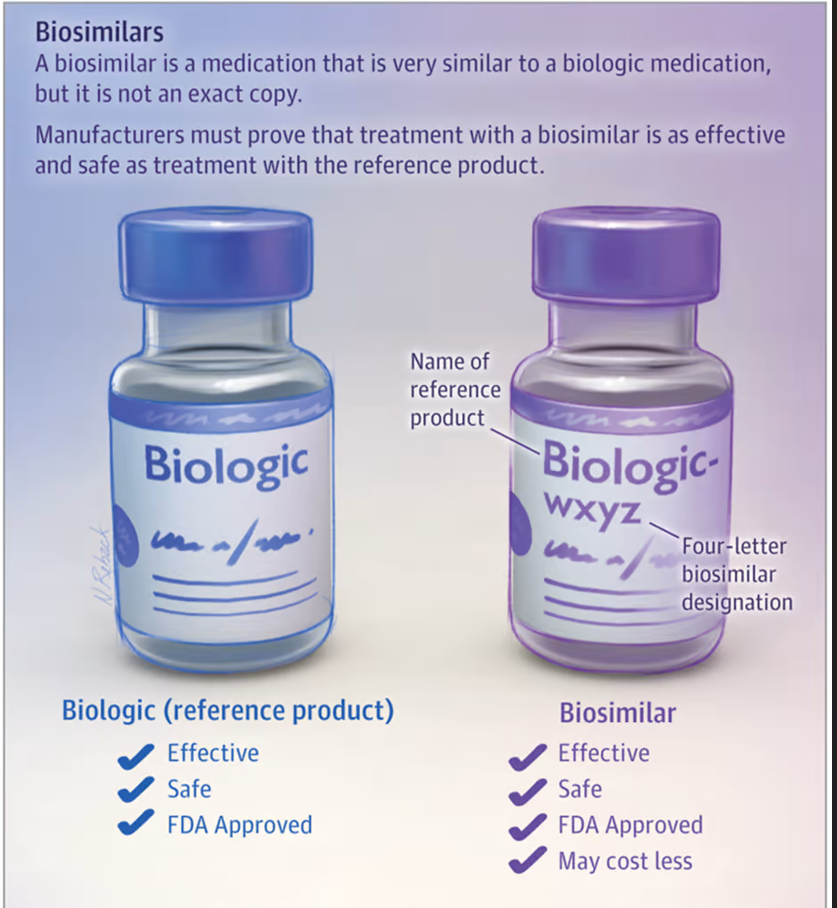
Biosimilars are highly similar to an existing biologic and must demonstrate no clinically meaningful differences in safety, purity, or effectiveness compared to the reference product. Unlike traditional generics, which are exact chemical copies, biosimilars are developed from living organisms and require a different regulatory pathway. [2]
As biosimilars become more widely available, they may influence both treatment access and specialty drug spending. Potential impacts include:
Increased competition
Expanded treatment access
Opportunities for cost savings
Widely used biosimilars now exist for medications such as:
Humira® (adalimumab)
Remicade® (infliximab)
Enbrel® (etanercept)
As biosimilar adoption continues to increase across healthcare, workers’ compensation programs may see opportunities for cost savings, although adoption varies across providers, payers, and jurisdictions. [2-5]
As more biologics lose patent protection and additional biosimilars enter the market, understanding these therapies will become increasingly important for organizations seeking to balance patient access with responsible cost management.
3. Determining Claim Relevance Is Becoming More Complex
As biologic use continues to expand, one of the most important questions in workers’ compensation is not simply whether a therapy is effective, but whether it is related to the claim and contributing to recovery.
Unlike traditional acute treatments, biologics are often prescribed for chronic inflammatory and autoimmune conditions that may exist independently of a workplace injury. As a result, determining the role of these therapies within a claim can be challenging.
Key considerations include:
Is the biologic treating a condition directly related to the injury?
Is it improving functional recovery or return to work outcomes?
Would the medication have been prescribed regardless of the workplace injury?
How should costs be allocated when work related and non-work related conditions overlap?
These questions become increasingly important as specialty medications continue to grow in both utilization and cost. Industry reports show that specialty medications can account for a disproportionately large share of pharmacy spend due to their high cost and long duration of therapy. [1,3]
The challenge for workers’ compensation stakeholders is balancing:
Access to clinically appropriate treatment
Evidence based care and decision making
Cost management
Overall claim outcomes
Without proper oversight, biologics can become a significant cost driver. When managed effectively, however, they can play an important role in improving patient outcomes and supporting recovery.
By Sarah Cirildo
PharmD
For questions, e-mail pharmd@prodigyrx.com
Citations
1. myMatrixx. Demystifying Drug Pricing: Specialty Drugs (Biologics and Biosimilars), Physician Dispensing and Compounding. Published February 6, 2024. Accessed July 9, 2026. https://www.mymatrixx.com/news/demystifying-drug-pricing-specialty-drugs-biologics-and-biosimilars-physician-dispensing-and

2. Academy of Managed Care Pharmacy. Biosimilar Drug Therapies. Accessed July 9, 2026.
https://www.amcp.org/legislative-regulatory-position/biosimilar-drug-therapies

3. WorkCompWire. Enlyte Releases Part Four of Pharmacy Solutions Drug Trends Report. Published August 29, 2024. Accessed July 9, 2026.
https://www.workcompwire.com/2024/08/enlyte-releases-part-four-of-pharmacy-solutions-drug-trends-report-2024/

4. Cardinal Health. 2024 Biosimilars Report. Published 2024. Accessed July 9, 2026.
https://www.cardinalhealth.com/content/dam/corp/web/documents/Report/cardinal-health-2024-Biosimilars-Report.pdf

5. Specialty Pharmacy Continuum. IQVIA analyst: biosimilar uptake remains uneven across molecules. Published October 2025. Accessed July 9, 2026. https://www.specialtypharmacycontinuum.com/Online-First/Article/10-25/IQVIA-Analyst-Biosimilar-Uptake-Remains-Uneven-Across-Molecules/78448 