

Short-Acting vs Long-Acting Opioids: Formulation Choices That Influence Workers’ Comp Claims
Introduction
Pain management plays an important role in workers’ compensation, influencing recovery timelines, treatment progression, and return-to-work outcomes. Opioids continue to be used in certain situations involving moderate to severe pain, but not all opioid therapies are the same. One of the most important prescribing decisions is often not whether an opioid is used, but which formulation is selected and when it is introduced. [1,7,8]
Short-acting and long-acting opioids act on the same receptors, but they behave differently in the body. How quickly they take effect, how long they last, and how they are managed over time can result in different treatment considerations and risk profiles. Studies have shown that opioid use in workers’ compensation claims may be associated with longer disability durations and higher overall claim costs, making formulation selection an important consideration throughout the recovery process. [2]
Ultimately, successful pain management is measured not only by pain relief, but also by improvements in function, participation in treatment, and progress toward recovery goals.
How Opioids Work and Why Formulation Matters
Opioids help relieve pain by binding to mu (μ)-opioid receptors in the brain and spinal cord, reducing the transmission of pain signals. These same receptors are also involved in breathing, mood, and reward pathways, which contributes to both the therapeutic effects and risks associated with opioid therapy. [4]
Formulation influences how a medication behaves over time.
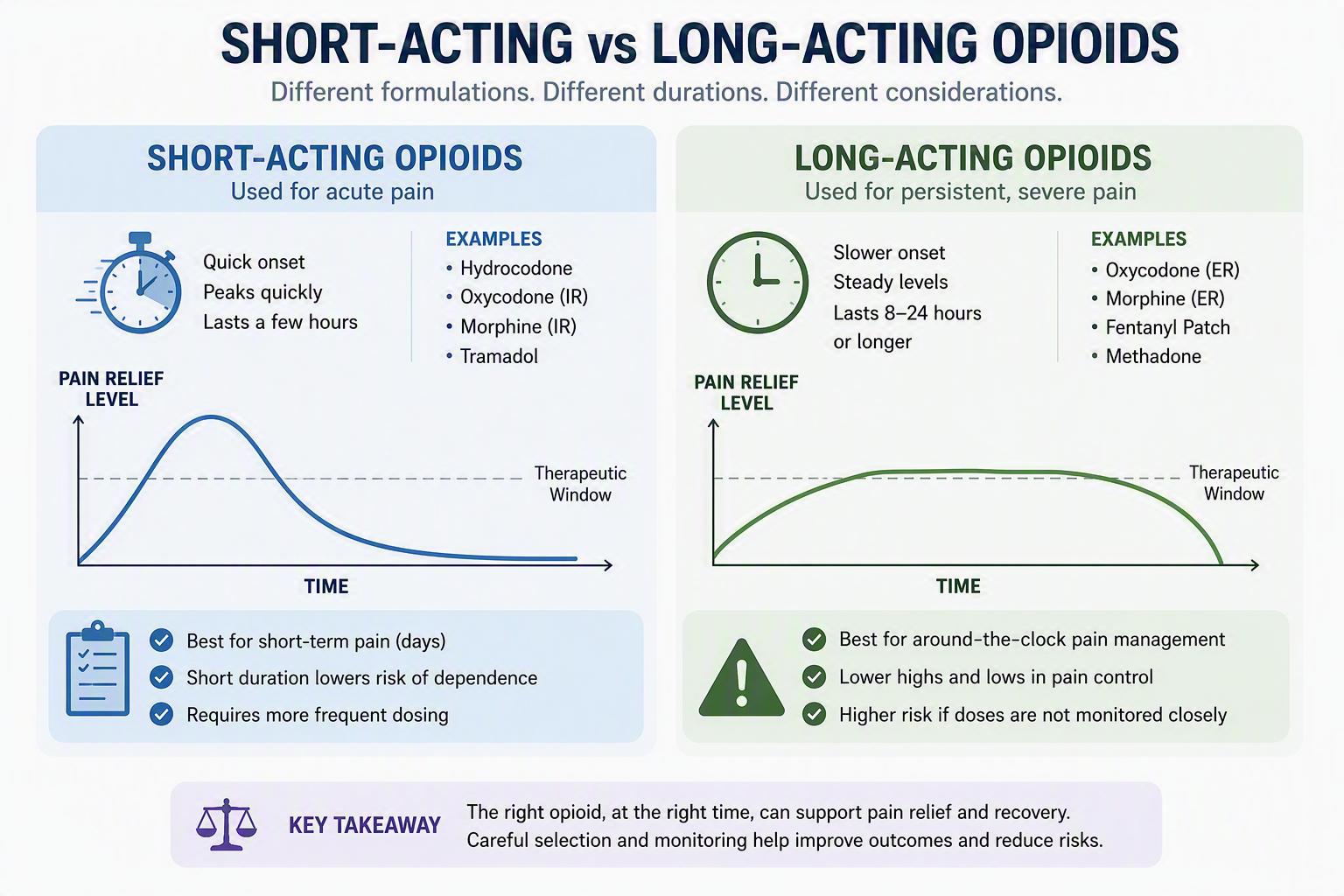
Short-acting opioids enter the bloodstream relatively quickly and typically provide pain relief for several hours. These medications are often used when pain levels fluctuate or are expected to improve as healing occurs.
Long-acting opioids release medication more slowly and are designed to maintain more consistent drug levels throughout the day. While this may reduce fluctuations in pain control, it can also introduce additional considerations related to dosing, monitoring, and patient response. [3,5]
In a workers’ compensation claim, formulation choice may influence how pain is managed throughout the recovery process and can affect treatment decisions over time.
When Short-Acting and Long-Acting Opioids May Be Appropriate
For many acute work-related injuries, if opioid therapy is considered necessary, short-acting opioids are often used initially for limited durations and at the lowest effective dose. This approach aligns with the expectation that pain will improve as healing progresses. [1,8]
Long-acting opioids are generally reserved for patients with persistent pain requiring around-the-clock management and who have demonstrated an appropriate response to opioid therapy. In workers’ compensation, this type of treatment is typically considered after careful evaluation of the patient's condition, treatment history, and functional goals. [1,7,8]
For PBMs and healthcare stakeholders, understanding these distinctions can support formulary management, utilization review, and clinical oversight efforts while maintaining access to appropriate pain treatment.
When Formulation Decisions Create Additional Risk
Both short-acting and long-acting opioids present unique considerations.
Short-acting opioids may require more frequent dosing and ongoing reassessment, while long-acting opioids require careful monitoring due to their extended duration of action. [3,5]
Challenges may arise when treatment plans are not regularly reassessed or when opioid therapy continues without evidence of meaningful functional improvement. Early use of long-acting opioids may warrant closer review to ensure treatment remains aligned with clinical needs, functional goals, and established prescribing guidelines. [1,7,8]
Safety remains an important consideration, particularly when opioids are used alongside other medications that may cause sedation, such as benzodiazepines or muscle relaxants. [1,6]
For PBMs, adjusters, and case managers, pharmacy data can provide valuable insight into how a claim is progressing. Potential indicators for additional review may include:
Early refill requests
Increasing total daily morphine milligram equivalents (MME)
New or increasing use of sedating co-medications
Multiple prescribers
Limited documentation of functional improvement over time
These indicators do not necessarily suggest inappropriate use, but they may signal opportunities for additional review and clinical intervention. [1,7]
Conclusion
In workers’ compensation, opioid formulation is one of several factors that can influence recovery, treatment progression, and overall claim outcomes.
Understanding the differences between short-acting and long-acting opioids can help support appropriate prescribing, informed clinical decision making, and effective pharmacy oversight. While opioid therapy may be appropriate for select patients, ongoing monitoring of utilization, function, and patient response remains critical.
Aligning treatment decisions with evidence-based guidelines and recovery goals can help support both patient safety and successful outcomes. [1,7,8]
By Mustafa Elhefnawi
PharmD Candidate (P3)
For questions, e-mail pharmd@prodigyrx.com
References:
1. Dowell D, Ragan KR, Jones CM, Baldwin GT, Chou R; Centers for Disease Control and Prevention. CDC Clinical Practice Guideline for Prescribing Opioids for Pain — United States, 2022. MMWR Recomm Rep. 2022;71(No. RR-3):1-100. doi:10.15585/mmwr.rr7103a1. CDC Clinical Practice Guideline for Prescribing Opioids for Pain — United States, 2022 | MMWR2. Franklin GM, Rahman EA, Turner JA, Daniell WE, Fulton-Kehoe D. Opioid use for chronic low back pain: a prospective, population-based study among injured workers in Washington State, 2002–2005. Clin J Pain. 2009;25(9):743-751. doi:10.1097/AJP.0b013e3181b2deal. Opioid Use for Chronic Low Back Pain: A Prospective, Population-based Study Among Injured Workers in Washington State, 2002-2005 | Semantic Scholar.3. U.S. Food and Drug Administration. Extended-Release (ER) and Long-Acting (LA) Opioid Analgesics Risk Evaluation and Mitigation Strategy (REMS). FDA; Updated 2023. Opioid Analgesic Risk Evaluation and Mitigation Strategy (REMS) | FDA4. Kosten TR, George TP. The neurobiology of opioid dependence: implications for treatment. Sci Pract Perspect. 2002;1(1):13-20. doi:10.1151/spp021113. The Neurobiology of Opioid Dependence: Implications for Treatment - PMC5. Chou R, Turner JA, Devine EB, et al. The effectiveness and risks of long-term opioid therapy for chronic pain: a systematic review for a National Institutes of Health Pathways to Prevention Workshop. Ann Intern Med. 2015;162(4):276-286. doi:10.7326/M14-2559. The Effectiveness and Risks of Long-Term Opioid... : Annals of Internal Medicine6. Centers for Disease Control and Prevention. Drug Overdose Deaths in the United States, 2022. National Center for Health Statistics; 2023. NVSS - Drug Overdose Deaths.7. Manchikanti L, Kaye AM, Knezevic NN, et al. Responsible, safe, and effective opioid prescribing for chronic non-cancer pain: American Society of Interventional Pain Physicians (ASIPP) guidelines. Pain Physician. 2017;20(2S):S3-S92. Responsible, Safe, and Effective Prescription of Opioids for Chronic Non-Cancer Pain: American Society of Interventional Pain Physicians (ASIPP) Guidelines - PubMed.8. American College of Occupational and Environmental Medicine (ACOEM). Opioids and Pain Treatment. ACOEM Practice Guidelines; 2017. ACOEM Practice Guidelines : Journal of Occupational & Environmental Medicine.